
Throughput #17
If you run a manufacturing operation with complex, project-based work, this probably feels familiar:
- Lead times keep stretching
- Backlogs keep growing
- Engineering is overloaded
- The shop floor feels congested
- Every new project makes things worse, and
- You have limited ability to take on new work
This isn’t a people problem.
It’s a “traditional project management” problem.
The trap: trying to hit 3 targets at once
For decades, project management has focused on hitting three goals:
- On time
- On budget
- On scope
The problem?
In high-variability environments (like today’s supply chains and manufacturing operations), you can’t reliably optimize all three.
So most teams end up here:
- Being late more often than not
- Constantly juggling priorities and blowing budgets
- Always reacting
The shift that changes everything
Instead of chasing all three goals, focus on one – this one:
👉 Deliver projects on time.
Because when you consistently hit project delivery dates:
- Cost and scope stays in control
- Time spent putting out fires drops
- Work flows more predictably
Now the real question becomes:
Why are projects almost always late — and rarely early?
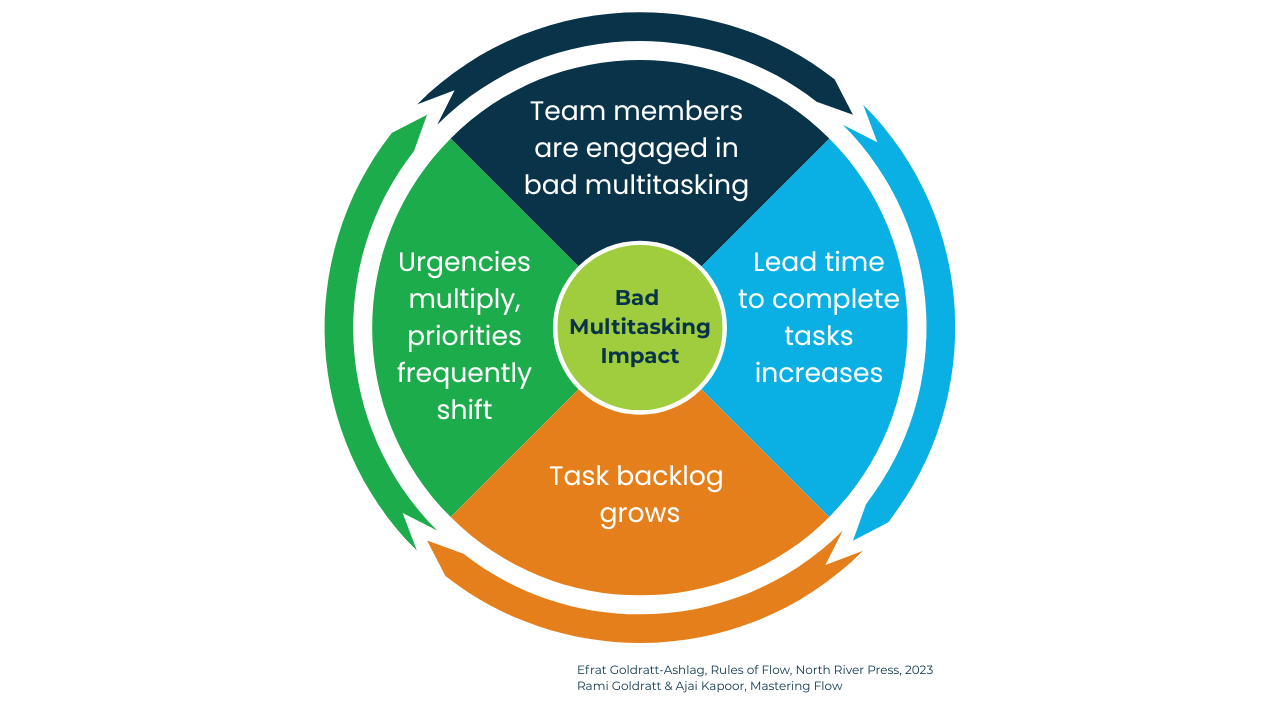
The real cause: multitasking and traditional project structure
The biggest driver of late projects isn’t bad planning.
It’s bad multitasking, related to how projects are structured and managed.
In most operations:
- Engineers and teams are spread across multiple projects
- Everyone is trying to meet individual task estimates
- Projects and tasks are encouraged to be initiated, but rarely finished quickly
It feels efficient. But it’s not.
What actually happens in traditional project execution:
- When a task finishes early → the next task can’t start (people are busy elsewhere)
- When a task finishes late → everything in front gets delayed
👉 Early gains are lost
👉 Delays stack up
Over time, “always late” becomes the norm. Traditional project structure can’t compensate, react nor prevent.
Eliminating bad multitasking (by staggering project releases in order to limit the number of projects worked on concurrently) is a core principle of Critical Chain methodology and one of the Rules of Flow.
Why project planning makes it worse
Traditional project plans are rigid:
- Fixed timelines
- Sequential steps
- Static priorities
They’re built like a train schedule. They have fixed stop and start times.
But real work doesn’t behave that way.
Some tasks finish early. Some finish late.
👉 Many systems are designed to absorb some delays — but not capture gains.
So even when things go right, it doesn’t help enough.
A critical chain approach removes the safety often embedded in each task and puts it as an aggregated project buffer at the end of the project network. This allows better management of task execution variability and improves project flow.
A task that’s delayed uses up some of this buffer, but doesn’t delay project completion.
A task that finishes early recovers some project buffer.
Like a shock absorber, the buffer enables gains to offset losses to minimize or eliminate the impact.
What this looks like in practice
Recently, we worked with a manufacturer of highly specialized robotic equipment — complex, engineer-to-order projects.
They were dealing with:
- Long, unpredictable lead times
- Overloaded engineering teams
- Shop floor congestion with high work in process
- Growing backlog
- Limited ability to take on new work
By applying Critical Chain principles and the Rules of Flow, supported by our Roadrunner Px project management software, they:
- Streamlined execution
- Reduced lead times by 25%
- Cut backlog by 30%
- Stabilized operations reducing operating costs
Most importantly:
👉 They created a predictable system.
This allowed them to take on (and deliver) more work with confidence. In addition, they expanded their operation by acquiring another company in the U.S. market.
Bottom line
If your projects are consistently late, the issue isn’t effort or intent.
👉 It’s that your project management approach is designed to maximize people’s efficiency instead of increasing project flow, which elongates lead times and increases operating costs.
Fix that, and performance changes fast.
Dive deeper
We shared this approach — and the full case example — at the Critical Chain 2026 Online Conference.
If you’re responsible for delivering projects in a manufacturing environment, it’s worth a look:
Thanks for reading!
— Jack Warchalowski, Montera CEO
[email protected]
Connect with me on LinkedIn
P.S. If you’d like your plant to perform better, get our free inventory imbalance report as the first step to greater efficiency, higher margins and long-term profitability.
Subscribe to Throughput, Montera’s manufacturing performance newsletter.