
Resources
Resources to help you solve persistent operations and supply chain problems for more productivity, revenue and profitability.

Essential reading
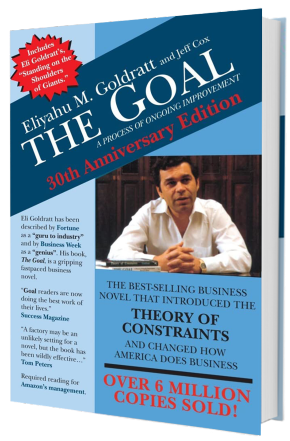
The Goal
What it is
One the world’s most-influential business books. In it, renowned author Eli Goldratt explains why traditional efficiency improvement methods fail, and offers a breakthrough alternative.
Why we recommend it
Everything we do is based on the Theory of Constraints methods outlined here. There’s no better way to learn what it is, and how we use it to drive-up performance.
Let us give you a free copy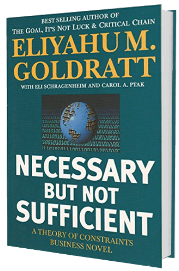
Essential reading
Necessary But Not Sufficient
What it is
“To realize value, bottom-line value, technology is Necessary but Not Sufficient.” NBNS outlines why most ERP investments, while often necessary, are not sufficient to deliver sustainable business results. System-wide based business management methodology and associated behaviour changes need to be driven outside of a technology platform to solve supply chain and operations management problems.
Why we recommend it
In its analysis of supply chain technology, NBNS ultimately outlines the basis for Demand Driven Replenishment and Production Management approaches and prescribes how to leverage your ERP investment to increase availability, reduce inventory and maximize system throughput.
Let us give you a free copyFEATURED POSTS
Tariff playbook: your most profitable path forward
Tariffs are outside your control. But you can control where you focus your constrained manufacturing capacity — and which markets you pursue.
How measuring efficiency can reduce productivity
Most manufacturers measure success at every work center. Here’s why that makes you less productive overall, and what to do instead.
The hidden cost of releasing too much work
After implementing Drum-Buffer-Rope, our client’s lead time dropped, they’re now shipping almost 20% more than they did a year ago, and revenue is up 20%.
ALL POSTS
Critical Chain Project Management
Improving project management for new product launch and development processes is an often overlooked way to boost your bottom line.
Boost productivity in 2025
How to use Throughput Velocity to determine relative product and market profitability.
Throughput Velocity reveals where your profit really lies
Cost-per-unit is a flawed analysis process to assess business profitability. Here’s why you should use Throughput Velocity instead.
Cut inventory without hurting revenue
How to reduce your inventory position – the right way – to cut costs without losing revenue.
Demand-driven replenishment
Case study on using Roadrunner Rx Inventory Management Service to optimize inventory levels and cut costs.
Demand-driven replenishment: what is it, why do it & how to start
Demand-driven replenishment is a Theory of Constraints methodology for supply chain management that responds to customer demand in real-time.