
Throughput #16
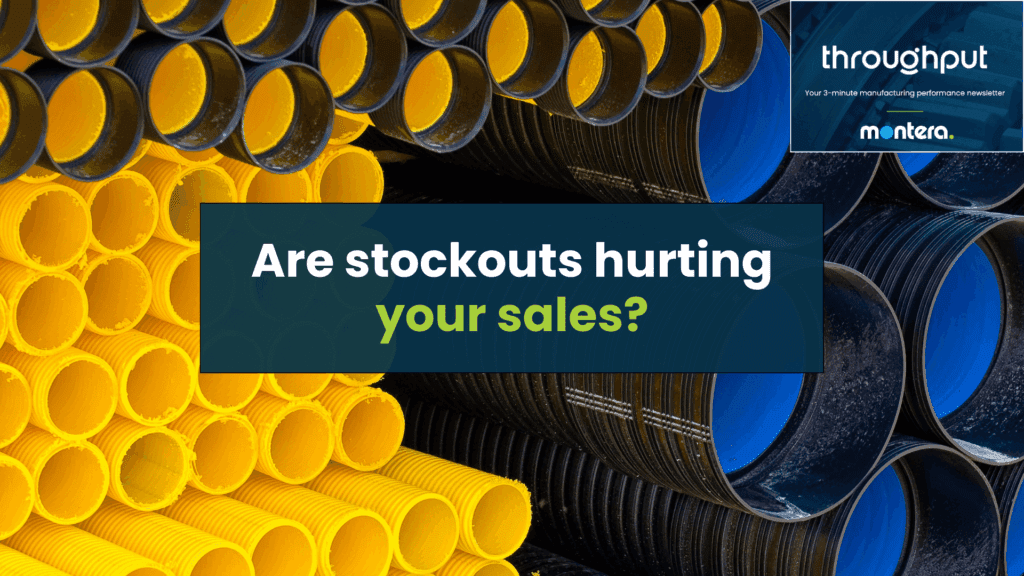
Years ago, we worked with one North American extrusion pipe manufacturer caught in a typical production capacity/stockout trap.
Pipe manufacturing is a tough business: it requires a highly efficient plant for success.
That means knowing how much of which products to produce, and when, so you have both stock availability and production capacity to fulfill orders during times of peak demand.
That’s not easy when you have hundreds of SKUs like our pipe manufacturing client did.
Missing out on significant sales
The pipe manufacturer came to us because they were losing significant sales every year due to poor product availability during the high-demand summer season when pipe is being installed.
This was despite running their machines constantly during the off-season according to their forecasts.
At the time, their scheduling decisions were influenced by un-shipped order quantities that skewed the real demand. They believed high inventory levels were required to fulfill seasonal business surges. (Inventory turns were historically very low).
But even that didn’t help.
A lack of availability and capacity at critical times
Every year when summer rolled around, they didn’t have what customers actually wanted, and by then it was too late: they had no capacity to make up the difference.
Their contractors and distributors expected that all products would be available for immediate or very fast shipment. Stockouts resulted in lost sales for more than just the stocked-out products as customers would take their business elsewhere.
Customers also overfilled the pipeline in the spring in a bid to ensure they’d be able to get product when they needed it.
But of course these customers wouldn’t know *exactly* what they would need (i.e., 4-inch or 6-inch pipe?). That increased production planning uncertainty and risk when customers updated orders at the last minute.
Plus, they and competitors would offer discounts to customers to take product in advance of need in order to reduce inventory and increase sales.
Enter Theory of Constraints (TOC)
We addressed the situation by implementing TOC methods at all 5 of their plants across North America.
This involved:
- Sales team input
- Stock buffer sizing (demand-driven replenishment / DDR)
- A structured system for production scheduling (drum-buffer-rope / DBR)
- A highly visible/interactive management tool (an early version of our Roadrunner software)
- Inventory reduction without impact to sales
We also:
- Synchronized supply chain replenishment with Canadian and US warehouses
- Established growth strategy based on profitability of customers and products
- Designed a unique Unrefusable Market Offer, based on the new DDR replenishment approach and DBR based plant capability, that was introduced to main Pipe customers
The client moved from a “Make to Forecast” model to a “Make to Availability / Consumption” approach based on newly designed inventory targets.
The problem with forecasts
The biggest shift was eliminating their reliance on a forecast, which is not easy for most manufacturers.
That’s because most people believe that the longer and more detailed their forecast is, the better off they are, because, otherwise, how will production know what to make?
But in reality the reliance on a forecast is a vicious cycle where everybody is forcing everybody else to try to predict something that’s totally unpredictable.
Forecasts create more problems from a production standpoint than they solve.
Capacity and a quick response are your best protection
The truth is you don’t need a better forecast to protect you, you just need capacity and speed.
That means having a little bit of inventory across the board that you can ship now.
So instead of predicting that you’re going to need a thousand of something, you design inventory buffers based on consumption patterns and how long it takes you to produce it.
As a result, if you know customers order 50 or 80 a time, you might have a hundred instead of a thousand of an item in stock. When you ship an order, that’s a signal for production to make more.
Real-time feedback tells you to build 100 of this SKU, 200 of that SKU, and 150 of some other SKU.
Too much inventory costs you money, capacity and most importantly time and effort to build it (you cannot build the right thing far in advance). A little bit of inventory is your friend.
Results
A year after the implementation, our client finally had enough capacity during peak season.
- Inventory dropped by 42%
- Availability increased and sales jumped 12% year over year despite difficult market conditions that saw industry-wide sales for piping products drop by over 1.5%.
The President and the VP of sales were thrilled.
“We have been able to accomplish higher sales with much lower inventories only because TOC and Roadrunner helped us manage our business priorities and define the appropriate sizes of the inventory stock buffers across the supply chain. I am confident we now know what to produce to meet customer demand, which is inherently different than the sales forecast,” the company president said after implementation.
Roadrunner software has evolved considerably over the last 20 years – this client is still using it today.
— Jack Warchalowski, Montera CEO
[email protected]
Connect with me on LinkedIn
P.S. If you’d like your plant to perform better, get our free inventory imbalance report as the first step to greater efficiency, higher margins and long-term profitability.